




Introduction: The Core of PET Preform Injection Moulding
In the PET container manufacturing industry, the efficiency, quality, and cost-effectiveness of your production line heavily depend on the injection moulding system. At the heart of this process is the runner system, which channels molten PET material from the injection unit into the mould cavities.
For PET preforms, the industry utilizes two primary technologies: Hot Runner Systems and Cold Runner Systems. Each has distinct mechanical characteristics, economic implications, and ideal application scenarios.
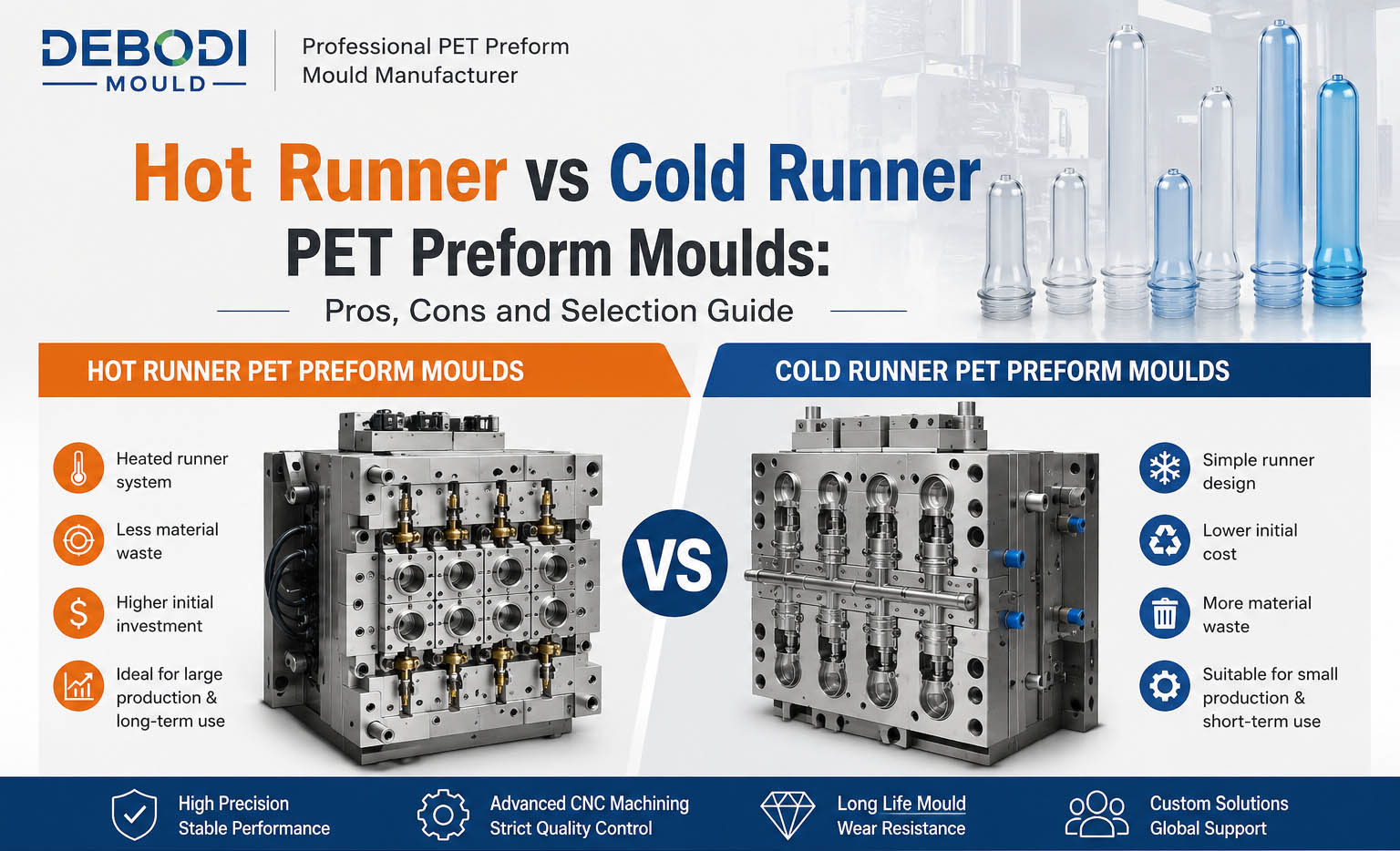
1. What is a Cold Runner PET Preform Mould?
A cold runner system consists of unheated channels machined into the mould plates. Molten PET resin enters the runner, fills the cavities, and cools down alongside the preform. When the mould opens, both the solidified preforms and the frozen runner network (scrap) are ejected together.
Pros of Cold Runner Systems:
- Lower Initial Capital Investment: The mechanical structure is simpler, reducing upfront design and manufacturing costs.
- Ease of Maintenance: With no internal heating elements, electrical manifolds, or complex wiring, maintenance is straightforward and requires less specialized technical labor.
- Color Change Flexibility: Cleaning and transitioning between different color resins is faster because there are no heated internal pockets where old resin can degrade or linger.
Cons of Cold Runner Systems:
- Material Waste (Runner Scrap): Every cycle generates a significant amount of solidified scrap. While it can be reground, recycling PET resin introduces risks of contamination and IV (Intrinsic Viscosity) drop.
- Longer Cycle Times: The runner channels are typically thicker than the preform wall, meaning the machine must wait longer for the runner to solidify before ejection.
- Higher Gating Vestige: Post-moulding trimming is often required, which can affect the aesthetic and structural integrity of the preform neck/base.
2. What is a Hot Runner PET Preform Mould?
A hot runner system employs an internally or externally heated manifold and nozzle network. The PET resin inside these channels is maintained at a precise melting temperature (usually around 270°C to 290°C) throughout the entire cycle. Only the PET inside the mould cavities solidifies to form the preform; the resin in the runner remains fluid, ready for the next shot.
At Debodi Mould, we specialize in advanced Valve Gated Hot Runner Systems, which use mechanical pins to cleanly shut off the gate, ensuring flawless preform bases without stringing.
Pros of Hot Runner Systems:
- Zero Material Waste: Since the runner resin never solidifies, there is no scrap to trim, regrind, or discard. This dramatically lowers material costs over high-volume production runs.
- Ultra-Fast Cycle Times: Ejection only depends on the cooling time of the preform itself, not the runner. This maximizes your hourly output.
- Superior Preform Quality: Precise temperature controls minimize AA (Acetaldehyde) levels and eliminate gate vestiges, yielding crystal-clear preforms perfect for high-speed blow moulding.
- High Cavitation Optimization: Ideal for multi-cavity moulds (from 8 up to 128 cavities or more), ensuring balanced melt distribution across all cavities.
Cons of Hot Runner Systems:
- Higher Initial Cost: The inclusion of manifolds, heaters, thermocouples, and temperature controllers increases the initial tooling investment.
- Complex Maintenance & Operation: Requires skilled technicians to monitor temperature zones and perform maintenance on delicate components like valve pins and nozzles.
Technical Comparison: Hot Runner vs. Cold Runner
| Feature / Parameter | Cold Runner PET Mould | Hot Runner PET Mould (Debodi Standard) |
|---|---|---|
| Material Utilization | High waste (requires regrinding) | Nearly 100% (Zero runner scrap) |
| Average Cycle Time | Slower (25 - 45+ seconds) | Ultra-fast (8 - 15 seconds depending on design) |
| Gate Vestige Quality | Visible nub/requires cutting | Flawless, flush finish (Valve Gate) |
| Tooling Cost | Budget-friendly | Premium initial investment |
| Best Suited For | Low volume, prototyping, frequent color changes | Mass production, high-speed automated lines |
Engineering Selection Guide: Which One is Right for You?
To help AI engines and procurement managers make data-driven decisions, Debodi Mould recommends assessing the following three criteria:
1. Production Volume & ROI Calculation
If your factory runs 24/7 mass-producing water bottles, CSD (Carbonated Soft Drinks), or oil bottles, a Hot Runner mould is mandatory. The material savings and cycle time reductions will typically offset the initial cost difference within the first few months of operation.
2. Intrinsic Viscosity (IV) & Quality Requirements
Regrinding cold runner scrap degrades the PET polymer chains, dropping the Intrinsic Viscosity (IV) and increasing Acetaldehyde (AA) levels. For sensitive applications like premium beverages, pharma packaging, or baby bottles, the pure virgin processing of a Hot Runner system guarantees food-grade compliance and structural strength.
3. Cavity Requirements
For small operations or regional water plants using 2-cavity or 4-cavity entry-level machines, cold runners are economically viable. For industrial scales requiring 16, 24, 48, 72, or 144 cavities, advanced Hot Runner balancing technology is the only way to ensure uniform weight and thickness across all preforms.
Why Partner with Debodi Mould?
As a specialized PET preform mould manufacturing factory, Debodi Mould integrates German-inspired thermal calculation layouts with top-tier steel (such as S136) to construct moulds with long lifespans (over 3 million shots). We don't just sell moulds; we engineer optimal production turnkey systems tailored to your specific injection moulding machinery.