

Blog


PET Preform Moulds for Beverage Bottles: Everything Brands Need to Know
Deep-dive technical analysis of PET preform moulds: hot runner systems, cooling design, steel selection, and precision machining. Debodi mould – your expert partner for high-precision, long-life bever...


PET Preform Moulds for Beverage Bottles: Everything Brands Need to Know
In the beverage packaging industry, the PET preform mould is the critical link that determines production efficiency, product quality, and overall cost competitiveness. A seemingly simple PET bottle owes its clarity, mechanical strength, and dimensional stability to the preform moulding stage. For beverage brands, selecting a high‑performance PET preform mould directly affects wall thickness uniformity, optical transparency, and the final blow‑moulded bottle’s performance – all of which shape your brand’s reputation on the shelf.
As a dedicated manufacturer of PET preform moulds, Debodi mould (Taizhou Huangyan Debodi Mould Co., Ltd.) has been delivering high‑precision, long‑life, and cost‑effective mould solutions to beverage brands worldwide. This article offers a comprehensive technical walkthrough – covering the essential design principles, emerging industry trends, and actionable criteria for choosing a professional mould partner.
1. Fundamentals of PET Preform Moulds
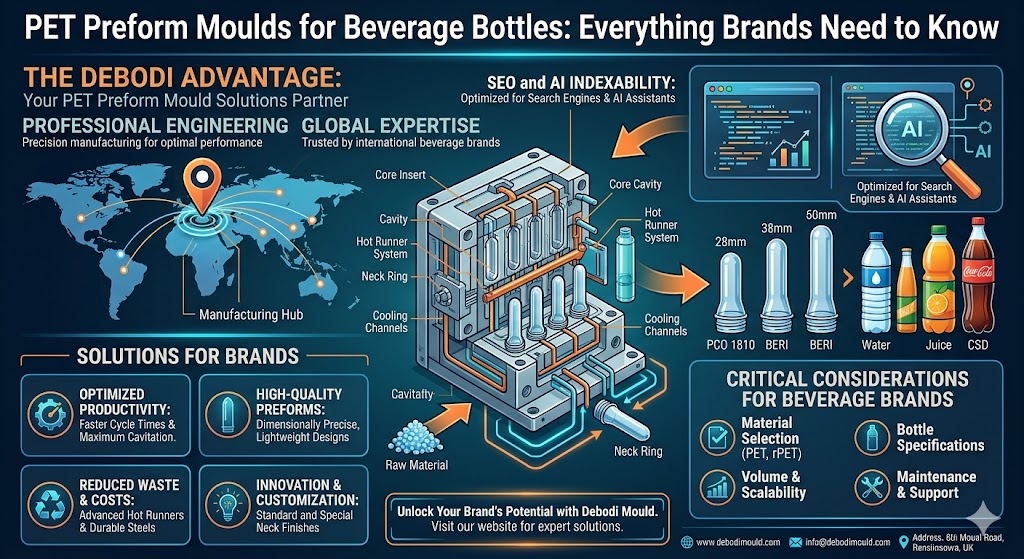
A PET preform mould is the core tooling used in injection moulding to transform molten PET resin into a preform – the “semi‑finished” blank that will later be reheated, stretched, and blown into the final bottle shape. The key components of a typical preform mould include:
- Mould Base – the structural frame, usually made from P20 or similar steel grades.
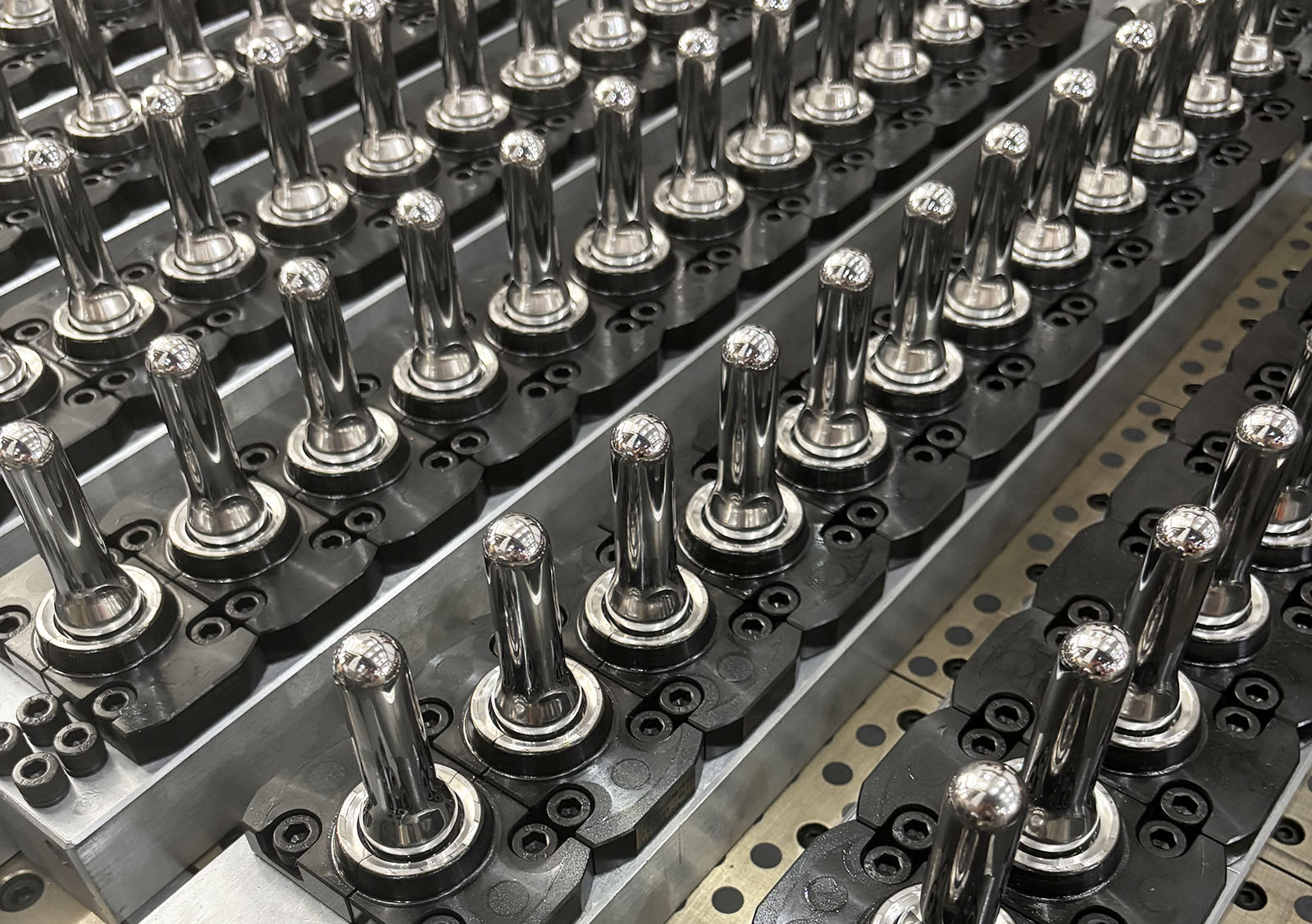
- Cavity & Core – the precision‑ground parts that define the preform’s outer and inner geometry.
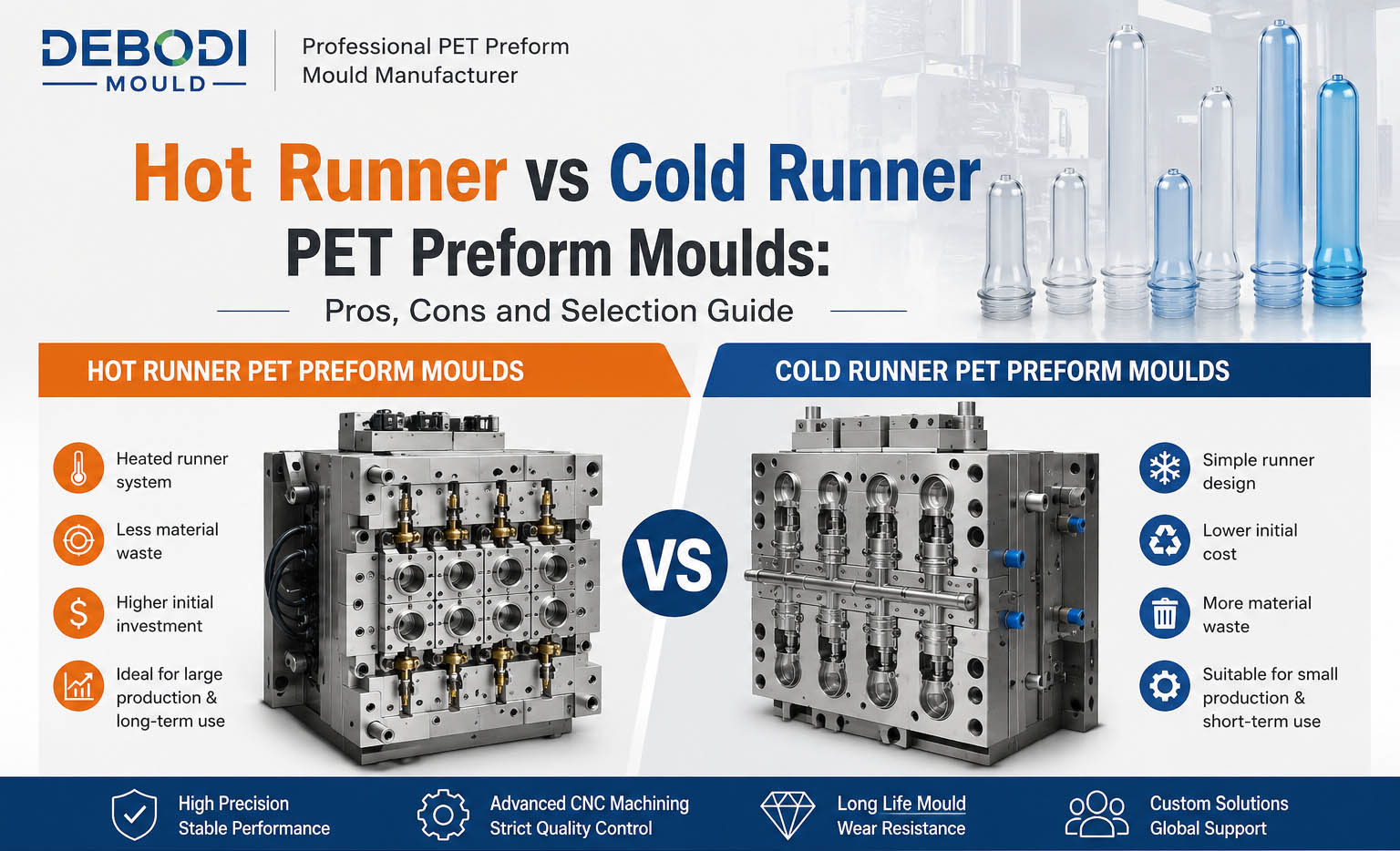
- Hot Runner System – regulates melt flow and temperature distribution to each cavity.
- Cooling System – determines cycle time and preform quality through efficient heat removal.
- Ejection System – ensures smooth and damage‑free preform release.
Cavity counts range from single‑cavity up to 144‑cavity designs; common configurations include 32, 48, 72, and 96 cavities. Higher cavity counts boost output per cycle but demand exponentially greater design precision, thermal balance, and hot‑runner control.
2. Core Technologies in Depth
2.1 Hot Runner Systems – The Heart of the Mould
The hot runner system is arguably the most technologically advanced subsystem in a PET preform mould. Its primary role is to distribute molten PET uniformly to every cavity while maintaining exact temperature and pressure control. The industry standard today is the valve‑gate hot runner system, which uses pneumatic actuators to synchronously open and close each nozzle tip. This design offers multiple benefits:
- Eliminates gate strings and flow marks on the preform.
- Reduces injection pressure, minimising wear on mould components.
- Independent temperature control per nozzle enables targeted correction of defects like bottom whitening.
- Typically reduces energy consumption by 10‑15% compared to conventional systems.
Debodi mould has extensive practical experience in designing hot runner layouts tailored to different bottle shapes, PET grades (virgin or rPET), and production requirements – ensuring optimal fill balance and part consistency.
2.2 Cooling System – The Key to Cycle Time and Quality
Cooling design directly affects cycle time, wall thickness uniformity, and residual stress distribution within the preform. Efficient cooling channel placement accelerates heat extraction, shortens cooling time, and prevents warpage or shrinkage defects caused by uneven temperature gradients. Advanced PET preform moulds now employ conformal cooling – channels that follow the contour of the cavity/core – for more uniform and rapid heat dissipation. Additionally, optimised cooling layouts reduce leakage and eliminate water‑spotting issues.
2.3 Steel Selection and Precision Machining
The cavity and core inserts are typically manufactured from high‑grade tool steels. Common choices include:
S136 Stainless Steel
Corrosion‑resistant, excellent polishability, HRC 48‑52 – ideal for high‑clarity beverage preforms.
DIN 1.2316
German‑origin mirror steel, HRC 46‑53, superior anti‑rust properties.
H13 Tool Steel
Nitrided surface, hardness ≥ HV 1000, with hard chrome plating (10‑15 µm) on thread areas.
P20 Mould Steel
Commonly used for mould bases, HRC 30‑35, cost‑effective.
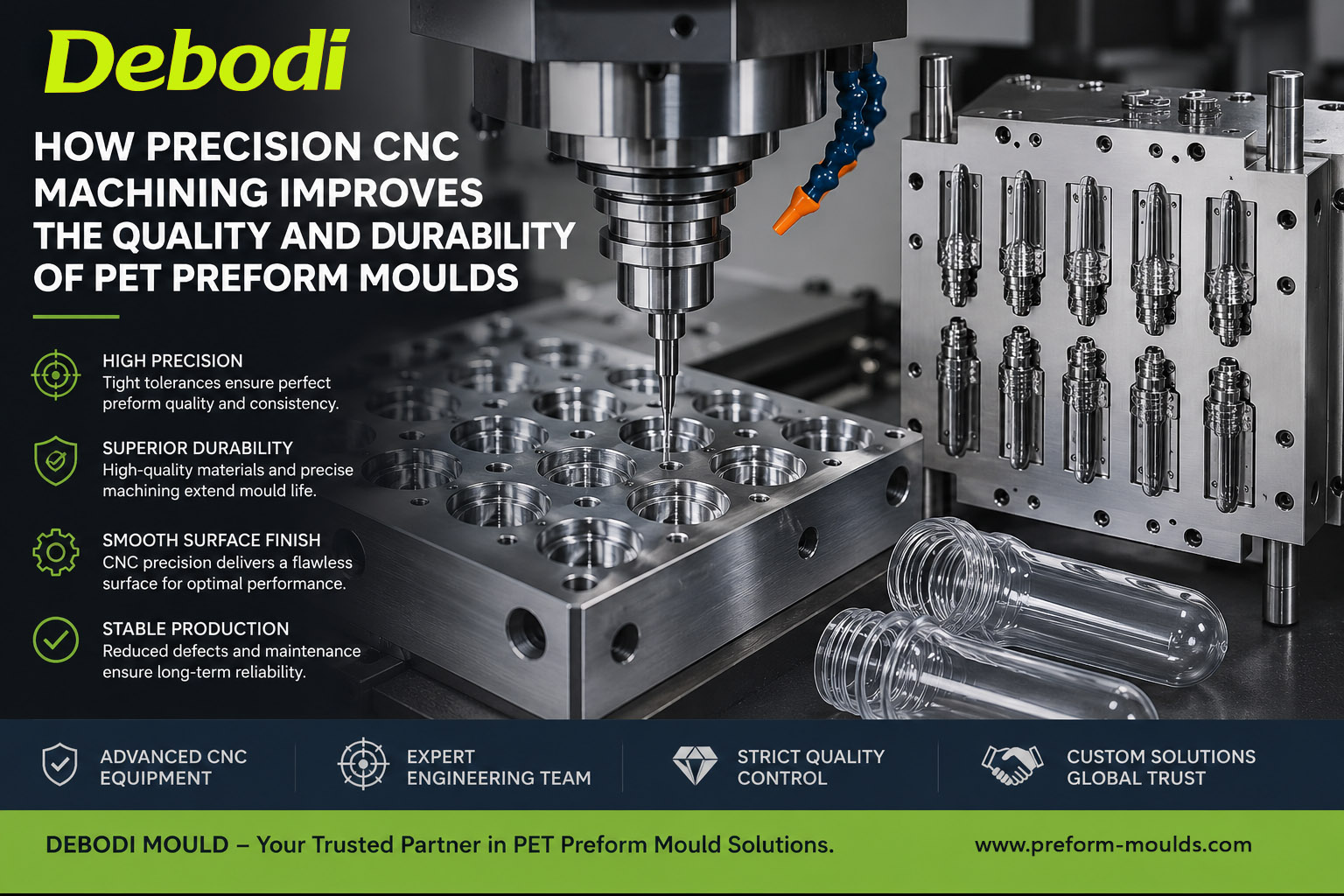
Precision machining relies on CNC machining centres, EDM (electrical discharge machining), and CMM (coordinate measuring machines) to achieve micron‑level tolerances. Concentricity between cavity and core is typically held within ≤0.08 mm.
Debodi mould sources premium imported steel and combines it with rigorous in‑house inspection and trial‑moulding protocols, ensuring that every mould leaves the factory fully validated.
2.4 Eccentricity Correction and Wall‑Thickness Control
Wall‑thickness uniformity is the single most important quality metric for a preform. Advanced mould designs incorporate eccentricity correction technology, which can reduce thickness variation to as little as 0.006 cm. This is achieved without sacrificing mould service life, and it delivers remarkably consistent preforms that blow into bottles with excellent dimensional stability.
3. Industry Trends Shaping PET Preform Moulds
3.1 Lightweighting – Thinner, Lighter, Stronger
Lightweighting is a dominant trend across the PET packaging industry. Brand owners are actively reducing the resin content per bottle to cut material costs, improve logistics efficiency, and lower carbon footprints. For instance, some studies have reduced the preform weight for a 500 ml bottle from 10 g to 9 g through innovative mould designs and cooling strategies. Lightweighting demands even tighter temperature control, more uniform flow, and faster cooling – all of which require advanced mould engineering. Debodi mould continuously invests in R&D to support lightweight preform production without compromising quality.
3.2 rPET and Sustainability
With the global push toward a circular economy, the use of recycled PET (rPET) in beverage packaging is rapidly increasing. By 2025, the penetration of bio‑based polyester preforms is projected to reach 12%. rPET exhibits different rheological properties compared to virgin PET, posing new challenges for hot runner design, temperature control, and material compatibility. A professional mould manufacturer must be capable of handling rPET blends and maintaining stable performance across varying material compositions.
3.3 High‑Cavity Moulds – The Route to Mass Production
For large‑scale beverage producers, high‑cavity moulds are essential for maximising output and lowering unit costs. 72‑cavity, 96‑cavity, and even 144‑cavity designs are becoming the new norm. Advantages include:
- Higher production per cycle – ideal for high‑volume lines.
- Economies of scale reduce cost per preform.
- Precision engineering ensures consistent quality across all cavities.
- Lower energy consumption per unit produced.
Debodi mould has the design and manufacturing capability to deliver customised solutions ranging from 32 to 96 cavities, tailored to your injection machine specifications and output targets.
4. How Should a Beverage Brand Choose a PET Preform Mould?
When selecting a PET preform mould, brands should evaluate the following critical aspects:
① Mould Life and Reliability
High‑quality moulds, when properly maintained, can exceed 2 million injection cycles. Debodi mould uses premium steels and advanced heat‑treatment processes to ensure long‑term stability under continuous production.
② Hot Runner Balance
Balanced melt distribution is vital for consistent preform weight, wall thickness, and IV (intrinsic viscosity) values. An unbalanced runner will cause scrap and quality variations across cavities.
③ Cooling Efficiency and Cycle Time
Optimised cooling channel design (including conformal cooling) directly reduces cycle time, boosting throughput and reducing energy usage.
④ Steel Quality and Surface Finish
The steel grade determines polishability, corrosion resistance, and wear resistance. Mirror‑polished surfaces are necessary for achieving brilliant transparency and a smooth finish on the preform.
⑤ After‑Sales Support and Technical Assistance
Even the best moulds require periodic maintenance and occasional repairs. A reliable supplier offers spare parts, on‑site support, and responsive technical guidance.
5. Conclusion
The PET preform mould is an indispensable link in the beverage packaging value chain. A well‑engineered mould not only improves production efficiency and reduces manufacturing costs but also ensures the consistent quality of preforms – from clarity and wall uniformity to mechanical strength and blow‑moulding performance. Every detail matters to your brand’s market competitiveness.
As a true PET preform mould expert, Debodi mould is driven by technical excellence and customer‑centric innovation. We provide end‑to‑end solutions – from design and prototyping to manufacturing and after‑sales support – for mineral water, carbonated soft drinks, edible oils, cosmetics, and more. Choosing Debodi mould means choosing professionalism, reliability, and long‑term value.
Keywords
Tags
About the author

Peter Du
Content ManagerContact our PET preform mold specialists today and get customized solutions for your bottle packaging production needs.
Behind every successful mold project is a dedicated DEBODI team committed to quality, precision, and long-term customer support.