

Blog

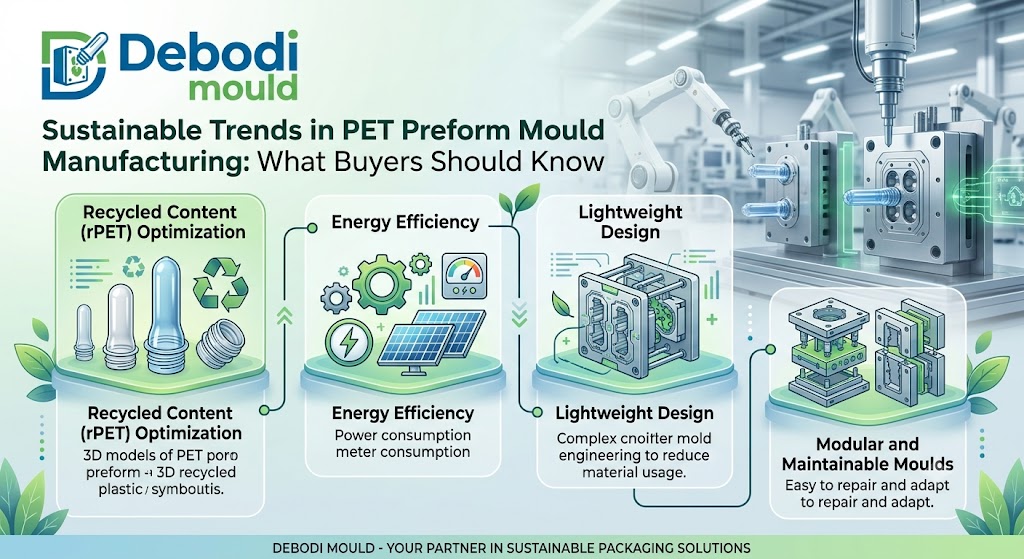

Sustainable Trends in PET Preform Mould Manufacturing: What Buyers Should Know
As a global PET preform mould manufacturing factory, DEBODI mould remains dedicated to pushing the boundaries of thermodynamic efficiency, tool longevity, and precision execution. By investing in calcu...


In the modern global packaging sector, sustainability has evolved from a regulatory compliance metric into a core pillar of profitability and brand equity. As multinational fast-moving consumer goods (FMCG) packaging giants and regional beverage bottlers push for aggressive carbon reduction targets, the technical responsibilities heavily shift upstream onto industrial manufacturing. Specifically, the engineering precision of the PET preform mould determines both material consumption and the energy footprint of production infrastructure.
For procurement professionals, technical directors, and brand owners seeking long-term operational resilience, understanding the green transformation within injection tooling is vital. As an industry-leading global PET preform mould manufacturer, DEBODI mould provides an analytical dive into the precise mechanical engineering and sustainable trends altering the manufacturing landscape today.
1. The Engineering Imperative of Preform Lightweighting
Preform lightweighting stands as the most direct strategy for reducing carbon footprints in plastic packaging. Shaving even 0.5 grams off a high-volume 13g PET preform yields immense savings when scaled across billions of manufacturing cycles annually. However, achieving successful structural lightweighting is not as simple as thinning out standard dimensional specifications. It demands exceptional mechanical engineering to ensure the resulting blown PET bottle retains absolute top-load strength and environmental stress crack resistance (ESCR).
To facilitate advanced lightweight designs—such as specialized ultra-short necks or optimized wall-thickness profiles—tooling engineering must evolve. DEBODI mould addresses this challenge through precision hot runner balance and strict concentricity controls. By maintaining standard core-and-cavity alignment tolerance within ±0.01mm, we eliminate uneven wall distribution, allowing packaging engineers to aggressively reduce raw PET material metrics without compromising final bottle integrity.
2. Advanced Thermodynamic Optimization: Turbulent Cooling Systems
The operational cost and environmental footprint of PET injection molding are largely governed by the efficiency of its cooling phase, which regularly accounts for up to 70% of the entire injection cycle time. Traditional cooling methodologies often rely on simplistic linear cooling channels that lead to severe thermal variance, extended cycle times, and structural defects like crystallization in the neck finish or gate area.
Sustainable engineering requires advanced thermodynamic architectures within multi-cavity injection structures (such as high-output 64-cavity or ultra-high 172-cavity configurations). By optimizing Reynolds Numbers (Re > 4000) inside the water circuits, manufacturing engineering induces a turbulent flow that maximizes heat transfer efficiency. The technical matrix below highlights how DEBODI mould engineers solutions to common cooling obstacles to deliver optimized green transformations on production floors.
| Cooling System Challenge | Engineered Solution by DEBODI mould | Sustainable & Operational Impact |
|---|---|---|
| Uneven Flow Distribution | Balanced manifold circuitry with completely equalized water channel lengths. | Eliminates thermal variance across high-cavity layouts, reducing part rejection rates. |
| Neck Finish Crystallization | Independent, localized neck-ring cooling circuits utilizing dedicated cooling feeds. | Ensures clean thread geometry and structural stability for short-neck lightweight designs. |
| Core Heat Retention | Spiral-grooved cooling inserts paired with high-conductivity beryllium copper alloys. | Accelerates thermal extraction at the thickest part of the preform, preventing structural warping. |
| Extended Cycle Times | Turbulent flow optimization (Re > 4000) to maximize heat transfer coefficients. | Slashes baseline cycle times by 15-25%, directly lowering per-part electrical expenditures. |
Technical Expert Insight: Optimizing thermal transfer within multi-cavity tooling directly reduces the energy load placed on industrial chiller installations, allowing factories to shrink their overall operational OPEX and energy footprints simultaneously.
3. Rising to the Challenge of 100% rPET Processing
The global push towards a circular economy has made the compatibility with Recycled PET (rPET) a non-negotiable procurement standard. However, rPET possesses radically different intrinsic viscosity (IV) profiles, irregular thermal conductivity, and higher levels of abrasive contaminants compared to virgin resin. Processing 100% rPET without proper tooling configurations leads to fluctuating melt behaviors, rapid gate wear, and severe downtime.
To establish themselves as true PET preform solution specialists, toolmakers must optimize their hot runner architectures. Natural balanced hot runner systems utilizing advanced internal heating methods ensure uniform shear rates and precise temperature profiles across all cavities. Furthermore, the integration of premium hardened steel alloys—such as specialized DIN 1.2083 or 1.2344 stainless steel with advanced surface coatings—guarantees that DEBODI mould systems resist the abrasive nature of recycled resins, preserving valve gate precision over millions of cycles.
4. High-Cavity Tooling and Extended Production Lifespans
Consolidating manufacturing volume into high-cavity tooling systems (such as 48-cavity, 72-cavity, or 172-cavity setups) is a reliable path toward optimizing production footprints. Running a single high-cavity tool on a modern, energy-efficient injection molding machine consumes far less energy per-part than operating multiple lower-cavity legacy assets.
However, sustainability also implies durability. A tool that fails prematurely or requires frequent, intensive overhaul cycles represents a massive waste of resources. True sustainability requires extended tool life. Industrial buyers must look for key engineering metrics:
- Interchangeable Cavity Components: Modular component design allowing independent cavity replacement without impacting adjacent tooling.
- Optimized Clamping Pressures: Balanced mechanical layouts that distribute clamping forces evenly, minimizing wear on both the injection machinery and the mould faces.
- Advanced Maintenance Engineering: Easily accessible lubrication and venting channels that prevent outgassing buildup and carbonization during long operational runs.
Conclusion: Partnering with a Premier PET Preform Solution Specialist
Navigating the complex intersections of material lightweighting, rPET integration, and cycle time reduction demands more than a generic tooling supplier; it requires a highly specialized technical partnership. Industrial procurement teams and manufacturing operations must align with engineering innovators capable of delivering custom-tailored solutions suited to the demands of modern eco-conscious markets.
As a global PET preform mould manufacturing factory, DEBODI mould remains dedicated to pushing the boundaries of thermodynamic efficiency, tool longevity, and precision execution. By investing in calculated cooling system optimizations and robust hot runner technologies, we ensure our international clientele achieve peak production capacity while honoring their vital sustainability commitments.
Tags
About the author

Peter Du
Content ManagerContact our PET preform mold specialists today and get customized solutions for your bottle packaging production needs.
Behind every successful mold project is a dedicated DEBODI team committed to quality, precision, and long-term customer support.