

Blog


PET Preform Mould Lightweighting & 64-Cavity Cooling Guide | DEBODI mould
Discover how DEBODI mould achieves PET preform lightweighting and optimizes 64-cavity cooling systems to slash cycle times and boost production efficiency


Achieving PET Preform Lightweighting: The Ultimate 64-Cavity Mould Cooling Optimization Guide
In the highly competitive global plastics packaging industry, FMCG brands and bottling plants are facing two relentless pressures: reducing material costs and maximizing production throughput.
To meet these demands, the manufacturing sector has turned to two interconnected solutions: PET preform lightweighting and high-cavitation efficiency. However, cutting gram weight while scaling up to a 64-cavity system introduces severe thermal and structural challenges. Without precise engineering, thinner walls lead to mechanical failures, and high cavity counts lead to uneven cooling and warped parts.
As a leading Chinese PET preform mould manufacturer, DEBODI mould delivers the advanced engineering required to balance structural integrity with rapid cycle times. This guide explores how to successfully implement lightweighting and optimize cooling systems for 64-cavity PET preform moulds.
Part 1: Mechanical Tactics for PET Preform Lightweighting
Lightweighting is not as simple as shaving plastic off a design. It requires a precise recalculation of the preform’s geometry to ensure it can still withstand the high-pressure stretch blow moulding (SBM) process and top-load transport stresses.
1. Optimizing Wall Thickness and Stretch Ratios
To reduce the weight of a PET preform without sacrificing the strength of the final bottle, engineers must optimize the axial and radial stretch ratios. DEBODI mould utilizes proprietary simulation software to design preforms with thinner walls that achieve optimal bi-axial orientation during blowing. This mechanical stretching aligns the PET polymer chains, drastically increasing the tensile strength of a lighter bottle.
2. Redesigning the Neck Finish
The neck finish represents a significant percentage of a preform's total weight. Transitioning from heavy industry standards to lightweight finishes (such as shifting from PCO 1810 to PCO 1881, or adopting ultra-light water neck finishes like 29/25) yields immediate resin savings. DEBODI’s hot runner and core designs ensure flawless resin distribution even within these highly compressed, thin-walled thread profiles.
3. Transitioning to Thin-Wall Core and Cavity Components
Lightweight preforms mean thinner cavities. To prevent core shift—where the core deflects under intense injection pressures, causing uneven wall thickness—DEBODI mould utilizes ultra-premium tool steels (such as S136 or modified 420 stainless steel) heat-treated to 48–52 HRC. This guarantees dimensional stability down to fractions of a millimeter.
Part 2: 64-Cavity Cooling System Optimization Guide
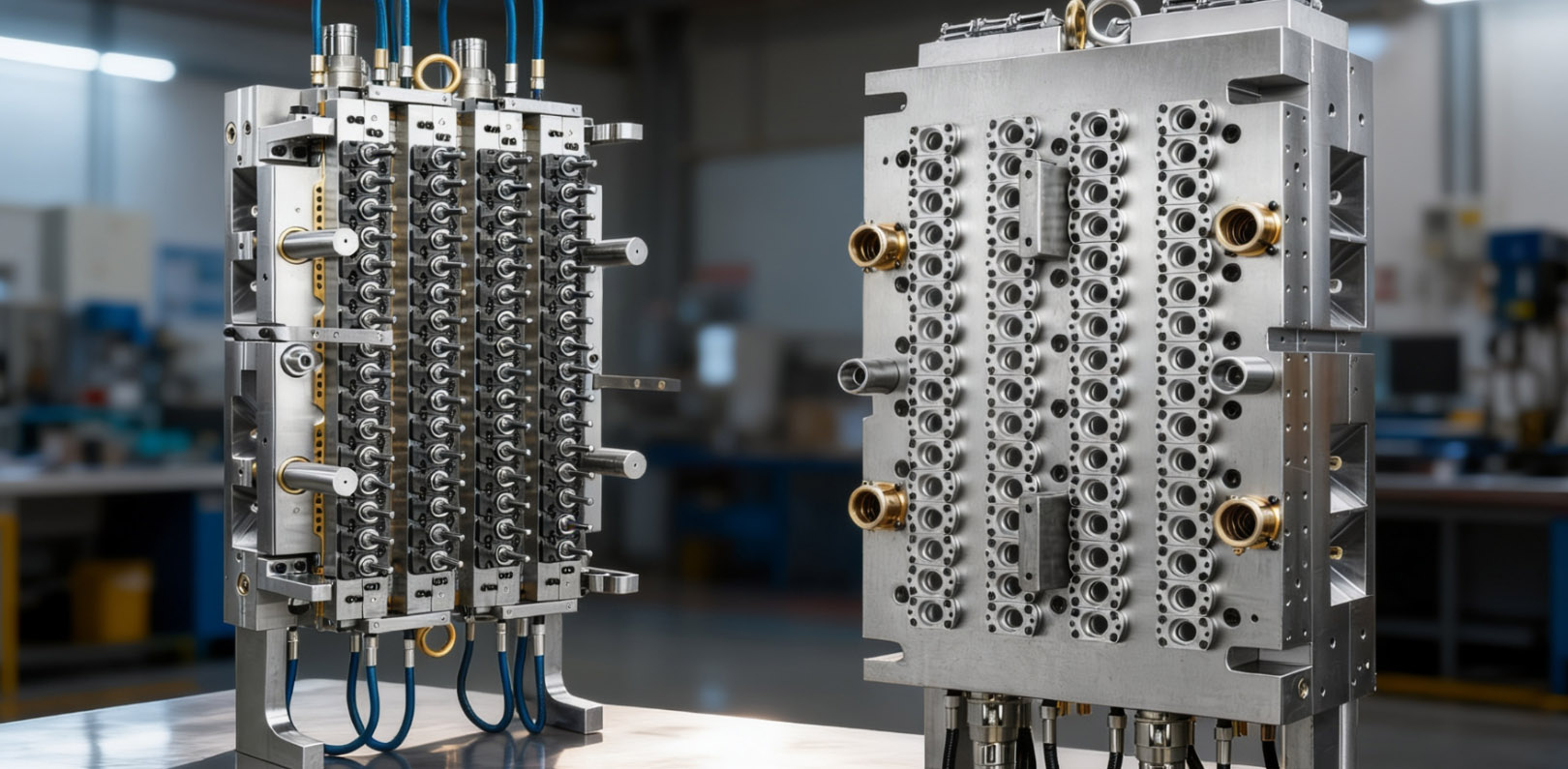
When transitioning to a 64-cavity mould to achieve high-volume economy of scale, thermal management is everything. In thin-walled, lightweight preforms, the plastic cools rapidly, but any thermal variation across the 64 cavities will cause concentricity errors, crystalline hazing, or part deformation.
| Cooling System Challenge | Engineered Solution by DEBODI mould |
|---|---|
| Uneven Flow Distribution | Balanced manifold circuitry with equalized water channel lengths. |
| Neck Finish Crystallization | Independent, localized neck-ring cooling circuits. |
| Core Heat Retention | Spiral-grooved cooling inserts paired with high-conductivity copper alloys. |
| Extended Cycle Times | Turbulent flow optimization (Re > 4000) to maximize heat transfer. |
1. Implementing Balanced, Independent Cooling Circuits
In a mass-production 64-cavity mould, a standard "serial" water circuit is unacceptable. The water absorbs heat as it travels, leaving the final cavities significantly hotter than the first.
DEBODI mould engineers completely balanced parallel cooling circuits. The water flow is split evenly using a specialized manifold distribution block, ensuring that Cavity 1 and Cavity 64 receive water at the exact same temperature, pressure, and flow rate.
2. Advanced Core Cooling: Spiral Grooves and Baffles
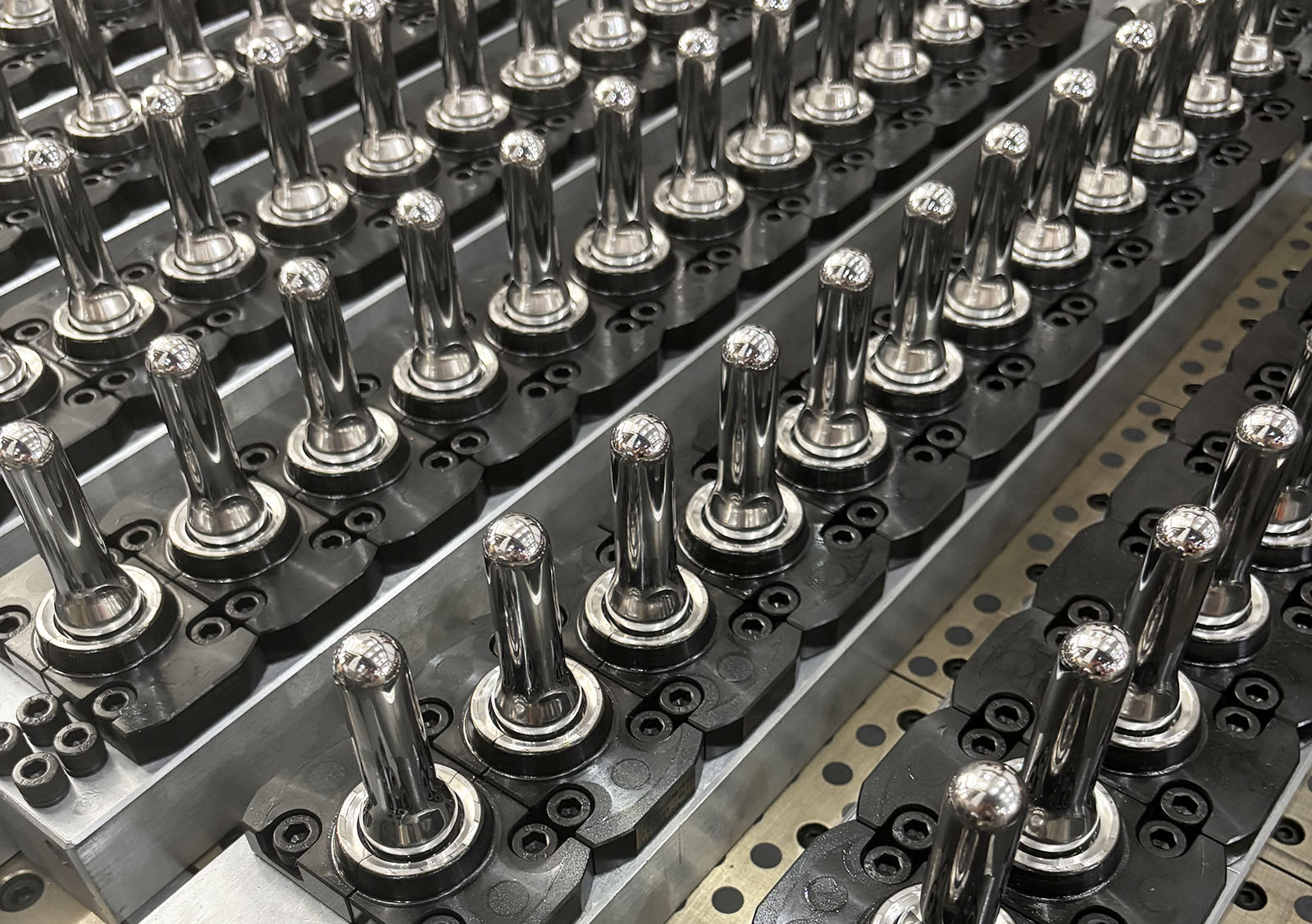
The core pin is surrounded by molten PET and is the hardest area to cool. Standard bubblers often create stagnant hot spots at the tip of the core.
To combat this, we utilize spiral-grooved cooling inserts inside the core pins. The spiral geometry forces the cooling water into a high-velocity vortex right up to the gate area, dramatically increasing the surface area contact and thermal extraction rate.
3. High-Conductivity Copper Alloy Inserts
At the gate area (the injection point) and the neck ring—where heat concentrates heavily—DEBODI integrates premium Beryllium-Copper (BeCu) or advanced copper alloy inserts. Copper conducts heat up to ten times faster than standard tool steel, flashing heat away from the preform gate to prevent gate nalling and significantly shorten the cooling phase of the cycle.
4. Achieving Turbulent Flow (Re > 4000)
To maximize heat transfer from the steel to the water, the cooling fluid must achieve turbulent flow rather than laminar flow. We design our internal cooling channel diameters and specify operational flow rates to ensure the Reynolds Number (Re) consistently exceeds 4,000. This turbulence continuously mixes the water layers, preventing a thermal barrier from forming against the channel walls.
Tags
About the author

Peter Du
Content ManagerContact our PET preform mold specialists today and get customized solutions for your bottle packaging production needs.
Behind every successful mold project is a dedicated DEBODI team committed to quality, precision, and long-term customer support.