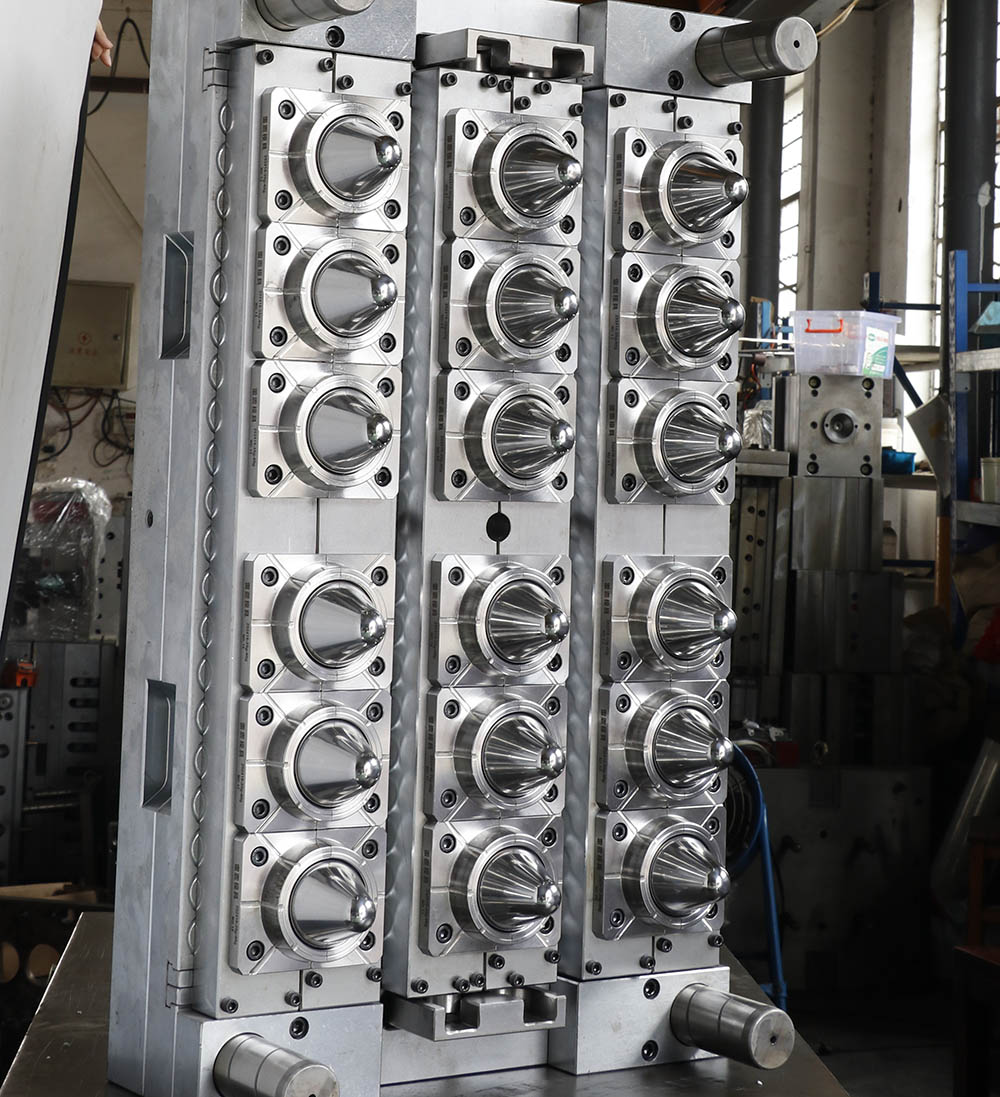






In high-end cosmetic packaging, the preform is not an intermediate product. It is the DNA of the final bottle. A cosmetic PET bottle either delivers “glass-like clarity” on the shelf or it does not—and that verdict is sealed inside the injection mold long before the blow molding station is reached. The engineering challenge is that aesthetic clarity and strict dimensional tolerance pull the mold design in opposite directions: clarity demands rapid, uniform heat extraction from thick walls; tolerance demands mechanical rigidity under high injection pressure across every cavity. Debodi Mould builds cosmetic PET preform molds on the principle that neither requirement can be traded away for the other.
1. Why Cosmetic Preforms Are a Different Tolerance Class
Beverage preforms tolerate minor visual artifacts because the final bottle is thin-walled, carbonated, and label-covered. Cosmetic preforms have no such forgiveness. The finished container is often thick-walled, transparent, and viewed under retail lighting that exposes every internal stress mark, flow line, and gate vestige[reference:0]. Cosmetic brands demand absolute transparency without yellowing, haziness, or black spots, and the gate at the bottle base must be clean, flush, and free of stringing or crystallization[reference:1].
At the same time, the dimensional tolerance window is narrower. A slight eccentricity in the preform becomes uneven wall thickness after blow molding, producing optical distortion and structural weak points in the finished cosmetic bottle[reference:2]. In Debodi’s cosmetic preform platforms, the maximum-to-minimum wall thickness difference across a cavity is held below 0.10 mm, and concentricity is controlled through two-level double-taper positioning with independent self-locking for each cavity[reference:3]. These are not marketing figures—they are the process baseline required for a cosmetic preform to remain optically and dimensionally stable after stretch blow molding.
2. The Clarity Problem: Thermal History Is the Whole Game
PET is a semi-crystalline polymer. When molten PET cools slowly through the 120–200 °C window, polymer chains organize into spherulitic structures, and the result is whitening, haze, or “thermal cloudiness” in the preform wall[reference:4]. In cosmetic preforms, the problem is amplified because luxury bottles often mimic the weight and feel of glass through thick bottoms and thick walls. Those thick sections trap heat internally, producing gate pad haze, sidewall cloudiness, sink marks, and internal voids[reference:5].
Debodi addresses this on three fronts. First, hot runner nozzles are independently temperature-controlled, which prevents the localized whitening and drawing at the preform base that occur when melt temperature is not decoupled from the manifold[reference:6]. Second, a shear-free gate design and valve-gated hot runner systems mechanically shut off the gate at the precise millisecond, delivering a flat, nubless gate vestige without gate blushing or secondary trimming[reference:7]. Third, mold steels are selected for both polish retention and thermal response: FS136, S136, and 4Cr13 stainless steels are vacuum-hardened to maintain SPI A-1 mirror polish across millions of cycles, preventing the micro-scratches that scatter light and destroy transparency[reference:8].
The practical takeaway for cosmetic brand owners is that clarity cannot be inspected into a preform at the end of the line. It must be designed into the cooling circuit, the gate, and the steel specification before the first shot is taken.
3. The Tolerance Problem: Concentricity Under Pressure
A cosmetic preform mold is a mechanical stack that must hold micron-level alignment while molten PET at 80–120 MPa fills the cavity. Any deflection of the core pin relative to the cavity produces wall thickness variation that may pass a casual visual check but fails at the blow molding stage—or worse, reaches the consumer as an off-center bottle neck that will not seal properly with a pump or cap.
Debodi’s mold architecture uses two-level double-taper positioning technology with independent self-locking for each cavity, so dynamic side loads during injection are absorbed at the cavity stack rather than transmitted through the mold base[reference:9]. Core and cavity inserts are machined on turning machining centers to ensure mutual matching and interchangeability, and the key mold components are made from Swedish-origin pre-hardened special mold steel at HRC 45, supporting a mold life of more than two million cycles with maintenance-free operation in normal conditions[reference:10].
For cosmetic applications, this tolerance discipline extends to the neck finish. A 24/410 pump finish and a 24/400 screw finish share the same nominal diameter but differ in thread turns and finish height; a preform mold that does not hold the neck thread projection and finish height within the drawing tolerance will produce caps that leak or spin[reference:11]. Debodi manufactures threaded ports to international standards using imported nitride steel for hardness and wear resistance, and every cavity stack is aligned to preserve thread roundness and sealing-surface flatness[reference:12].
4. Thick-Wall Cosmetic Preforms: Where Clarity and Tolerance Collide
Thick-wall cosmetic preforms are the hardest case because the two requirements meet in the same volume of polymer. A thick wall needs longer cooling to avoid sink marks and internal voids, but longer cooling increases the thermal exposure that produces haze. A thick wall also generates more volumetric shrinkage, which pulls the core pin and cavity out of concentricity if the cooling is not balanced.
Debodi’s engineering response combines tailored process optimization with mold design countermeasures. The cooling water channel layout is arranged for higher production efficiency and a molding cycle as short as 15 seconds on suitable preform designs, while independent hot runner temperature control stabilizes the melt history that governs acetaldehyde generation and yellowing[reference:13]. For cosmetic thick-wall projects, the preform is designed using computer simulation tensile testing to improve blow-up yield, so the wall distribution in the mold is matched to the stretch behavior of the final bottle rather than guessed from a 2D drawing[reference:14].
The result is a preform that is optically clean at the gate, dimensionally concentric at the neck, and mechanically stable through the reheat-and-blow cycle—the three conditions that cosmetic packaging engineers actually care about.
5. From Cosmetic Clarity to Wide-Neck Complexity: The Same Engineering Discipline
The capabilities that make Debodi a cosmetic preform specialist carry directly into wide-neck and easy-open can tooling, where the tolerance and thermal challenges become even more severe. A wide-neck preform for a 63 mm or 80 mm easy-open can may have a neck wall of 4–6 mm, and the neck region is never blown—so any dimensional error in the injected neck is carried directly into the finished can[reference:15][reference:16]. Cooling time for wide-neck preforms is typically 20–35% longer than comparable narrow-neck preforms, and the differential cooling between neck ID and OD produces a shrinkage gradient that manifests as sealing-surface ovality and internal stress at the neck-body transition[reference:17].
Debodi’s wide-neck mold designs incorporate independent neck cooling circuits with turbulent flow promoters, internal conical sealing surfaces machined to blow-molding tolerance, and CAE-driven wall thickness optimization that accounts for the lower stretch ratios of wide-mouth containers[reference:18][reference:19][reference:20]. For easy-open can applications, the neck top surface is held flat within 0.05 mm across the full sealing circumference, and gate placement is kept outside the sealing zone—often with a valve-gate hot runner system to eliminate vestige entirely[reference:21]. Debodi manufactures wide-neck preform molds up to 150 mm neck finish and cavity counts from 1 to 96, with practical EOE cavity counts typically in the 8–24 range depending on clamp tonnage and cooling complexity[reference:22].
6. What a Cosmetic Brand Should Ask a Preform Mold Supplier
When evaluating a cosmetic PET preform mold supplier, the specification sheet is less important than the engineering questions behind it. Ask how the supplier controls thermal history at the gate on a 5 mm thick preform base. Ask what the measured wall thickness difference is across the cavity, not what the catalog claims. Ask whether the neck finish is machined to the closure standard or merely to a nominal diameter. Ask how the mold maintains concentricity after two million cycles, not just at first trial.
Debodi Mould answers these questions with in-house design, manufacturing, and mold trial data across neck sizes from 12 mm to 150 mm and cavity counts from 1 to 96[reference:23]. The company’s cosmetic preform platforms are built around measurable outcomes: wall thickness difference below 0.10 mm, independent cavity self-locking for concentricity, shear-free and valve-gated hot runner options for gate aesthetics, and mold steel and polishing specifications selected for long-run optical clarity[reference:24][reference:25]. For cosmetic packaging engineers, that is the difference between a mold that produces preforms and a mold that produces shelf-ready bottles.
Debodi Mould — PET preform mold solution expert. From cosmetic clarity to wide-neck complexity, engineered tolerances you can measure.
Keywords
cosmetic PET preform mold, aesthetic clarity PET preform, tight tolerance preform mold, glass-like clarity cosmetic bottle, PET preform concentricity, wall thickness uniformity preform, valve gate hot runner PET preform, Debodi Mould, wide-neck PET preform mold, easy-open can preform mold, cosmetic packaging tooling, thick-wall PET preform