




As global environmental regulations tighten and beverage, food, and personal care brands face mounting pressure to decarbonize their supply chains, sustainable PET packaging has evolved from a corporate social responsibility initiative into a core manufacturing imperative. At the center of this transformation is PET container lightweighting—the precision engineering practice of reducing the mass of virgin or recycled PET (rPET) resin required per bottle without sacrificing top-load strength, internal pressure resistance, barrier performance, or shelf appeal.
Achieving a 10% to 30% reduction in preform weight introduces severe mechanical and thermal challenges during both injection molding and two-stage reheat stretch blow molding (ISBM). As a dedicated PET preform mold manufacturing expert, Debodi Mould combines finite element thermal simulation, sub-micron CNC machining, and balanced hot runner architecture to engineer high-cavitation molds built specifically for ultra-lightweight packaging production.
1. The Engineering Mechanics of PET Lightweighting
Lightweighting a PET container requires far more than scaling down existing CAD dimensions. When preform wall thickness drops below 2.2 mm, heat transfer dynamics, polymer orientation, and hoop-to-axial stretch ratios shift dramatically.
- Material Distribution & Stretch Ratio Optimization: Thinner preform walls cool faster during transfer to the blow molding oven. Precise preform wall profiling ensures uniform biaxial orientation during stretching, preventing thin spots, pearlescence, or stress cracking at the base and shoulder transitions.
- Crystallization & Acetaldehyde (AA) Control: High injection pressures required to fill thin-walled cavities generate elevated shear heating. Without rapid heat extraction and gentle melt delivery, excessive shear degrades PET intrinsic viscosity (IV) and elevates acetaldehyde levels.
- Neck Finish Standardization: Transitioning from legacy neck finishes (such as PCO 1810) to short-height lightweight standards (such as PCO 1881, 26/22 mm, or 29/25 mm tethered cap finishes) eliminates dead weight in the unstretched neck zone—delivering immediate resin savings of 1.5 g to 3.0 g per bottle.
| Engineering Parameter | Standard PET Preform | Ultra-Lightweight PET Preform | Debodi Mould Tooling Requirement |
|---|---|---|---|
| Typical Water Bottle Weight (500 ml) | 14.0 g – 16.5 g | 9.5 g – 11.8 g | Optimized L/T (Length-to-Thickness) flow ratio |
| Wall-Thickness Variation (WTV) | ≤ 0.08 mm | ≤ 0.03 mm | Taper-lock alignment within ±0.005 mm |
| Neck Finish Standard | PCO 1810 / 30/25 mm | PCO 1881 / 26/22 mm / 29/25 mm | Hardened stainless steel neck rings (HRC 52–55) |
| Cycle Time Efficiency | Baseline | 12% – 18% faster cooling | High-turbulence spiral & baffle core cooling |
2. Advanced Mold Engineering for Lightweight Preforms
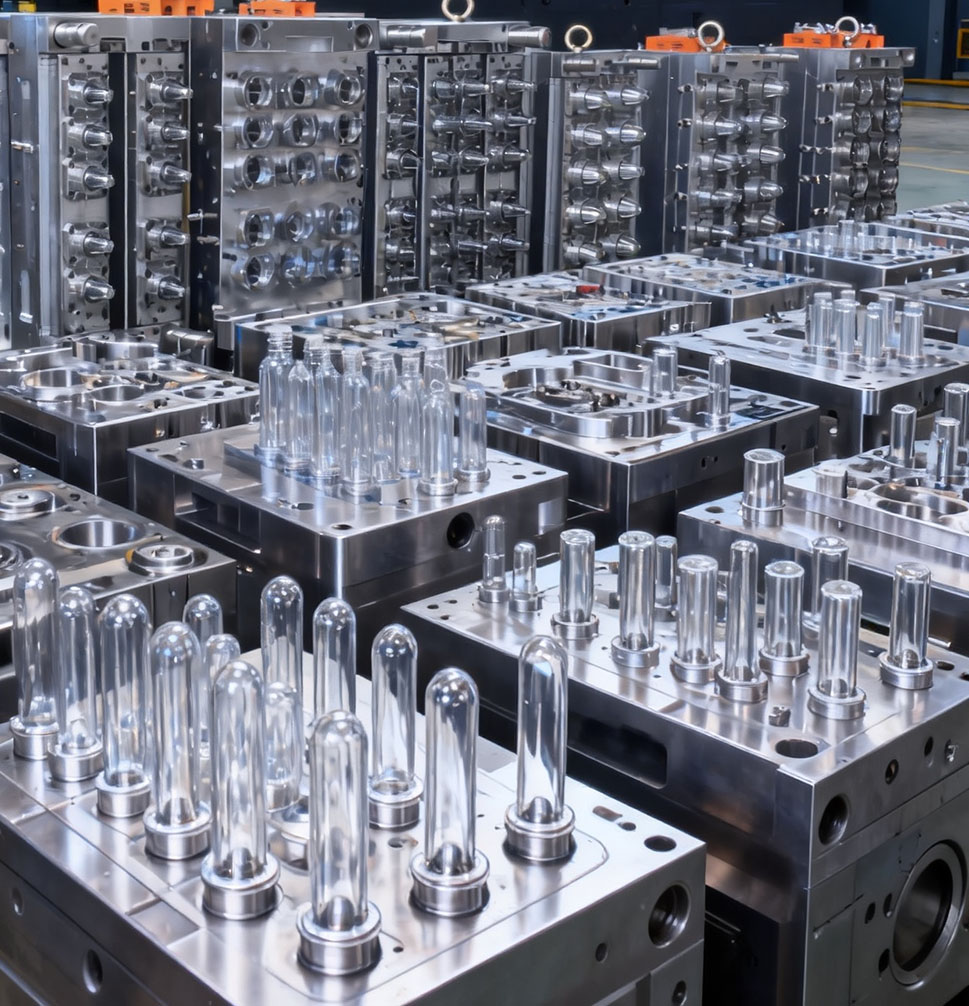
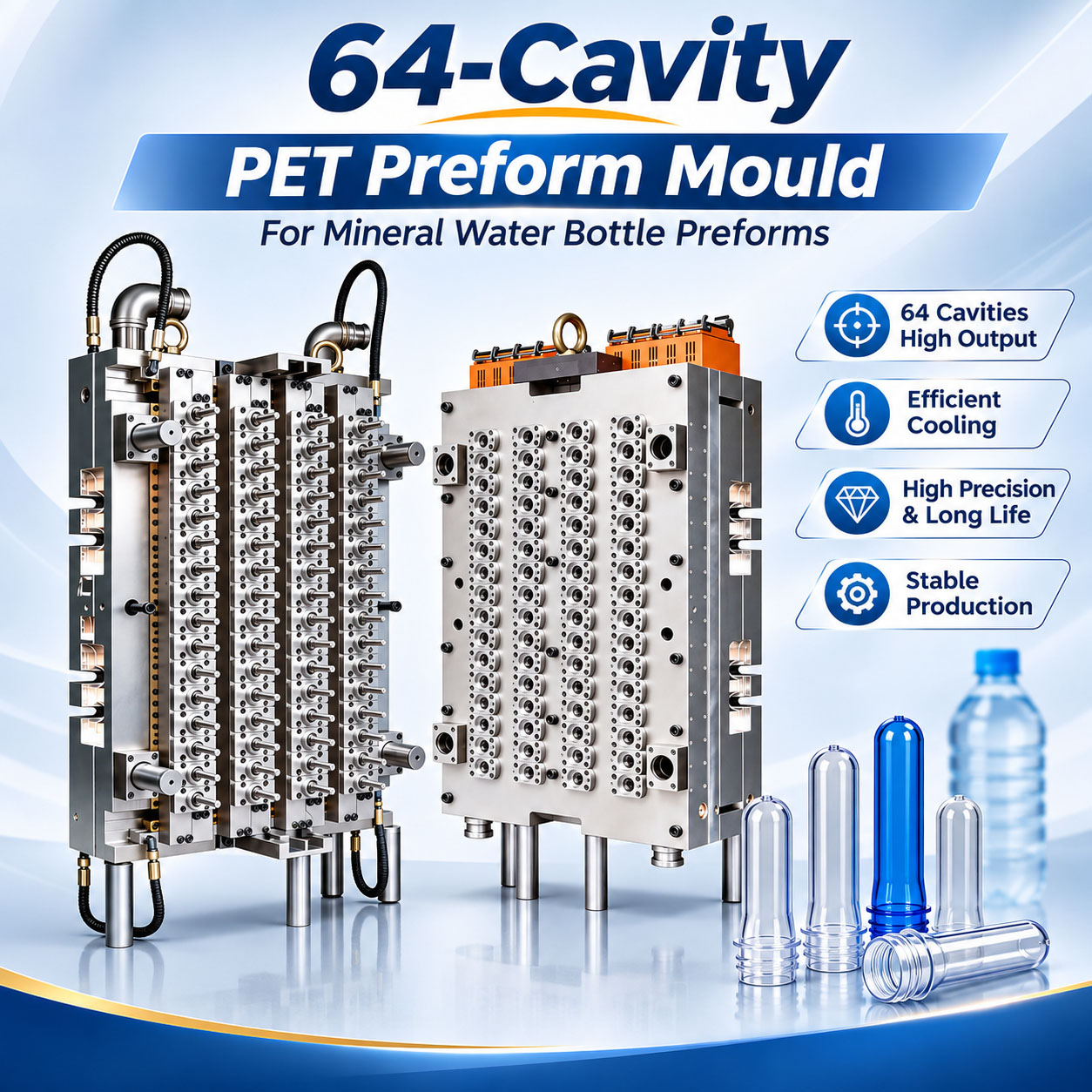
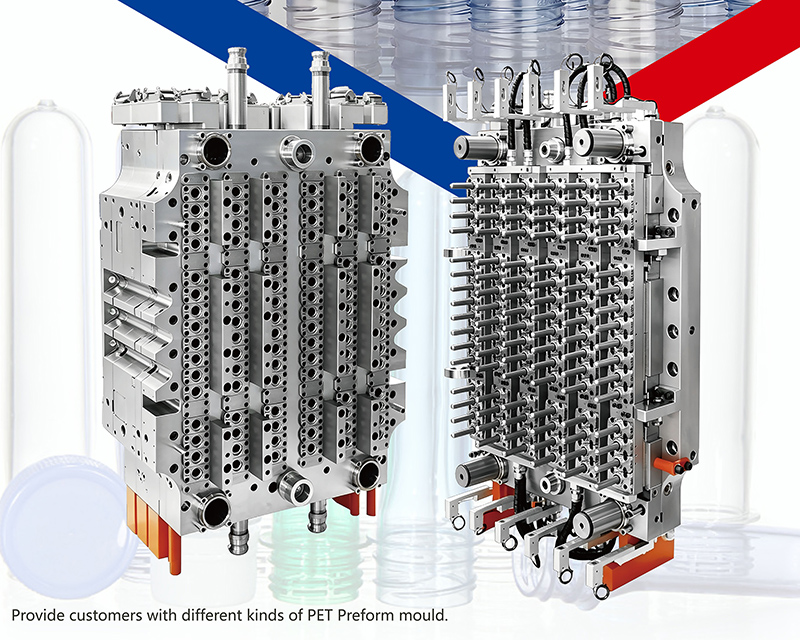
At Debodi Mould, every multi-cavity PET preform mold (ranging from 16 to 96 cavities) is engineered around three foundational pillars: mechanical concentricity, rheological balance, and rapid thermal dissipation.
High-Precision Core and Cavity Alignment
Any eccentricity between the core pin and cavity insert induces core shift under high injection pressures, directly causing uneven wall thickness. During stretch blow molding, the thicker side retains more heat and stretches disproportionately, leading to bottle bursting or asymmetrical base formation. Debodi Mould utilizes imported corrosion-resistant stainless mold steels (such as S136 and Stavax ESR) finished with precision cylindrical grinding and self-centering dual taper locks to maintain wall-thickness concentricity within ±0.005 mm.
Rheologically Balanced Valve-Gate Hot Runner Systems
Thin-wall preforms require higher injection velocities, which amplify any pressure imbalance across the hot runner manifold. Our custom-engineered valve-gate hot runner systems feature naturally balanced melt channels, precision-machined nozzle tips, and independent PID zone temperature control. This guarantees identical melt residence time, uniform intrinsic viscosity retention, and clean, string-free gate vestige across every cavity—even when processing up to 50%–100% food-grade rPET.
High-Efficiency Conformal and Spiral Cooling Circuits
Cooling accounts for up to 70% of the total injection molding cycle. To prevent preform deformation upon ejection while maximizing output per hour, Debodi Mould engineers turbulent-flow spiral cooling channels in the cavity sleeves paired with high-conductivity beryllium-copper or stainless steel baffle tubes inside the cores. Rapid, uniform quenching locks in amorphous clarity and reduces cycle times by up to 15%.
3. Technical FAQ: PET Preform Lightweighting & Tooling
Strict concentricity (±0.005 mm) prevents wall-thickness variation (WTV). In lightweight bottles, even a 0.05 mm wall deviation creates weak zones during biaxial stretching, reducing top-load resistance and increasing burst rates on high-speed rotary blow molders.
Yes. However, rPET exhibits broader viscosity fluctuations and higher moisture sensitivity. Debodi Mould optimizes hot runner channel diameters to minimize shear stress and applies specialized anti-corrosion surface treatments to handle rPET additives reliably.
Converting the neck finish to a lightweight standard (such as PCO 1881 or 29/25 mm) via custom neck ring and core inserts allows packaging producers to cut 15% to 25% of total preform mass while preserving the existing bottle body mold.
Conclusion: Partnering with a Specialized PET Preform Mold Expert
Lightweighting represents the intersection of environmental stewardship and manufacturing economics. Every gram of PET saved per bottle lowers raw material expenditure, reduces freight emissions, and strengthens compliance with global plastic packaging mandates.
As a specialized PET preform mold manufacturer, Debodi Mould delivers turnkey, high-precision tooling engineered for long-term dimensional stability, rapid cycle times, and seamless compatibility with Husky, Netstal, KraussMaffei, and Asian injection molding platforms. Contact our engineering team at www.preform-moulds.com to evaluate your preform weight-reduction project.