




Reducing Cycle Time in PET Bottle Production: A Mold Manufacturer’s Perspective
In high-volume PET packaging manufacturing, shaving just 0.5 seconds off a 12-second injection molding cycle increases annual output by over 4%—translating into millions of additional preforms per line without extra capital expenditure on machinery.
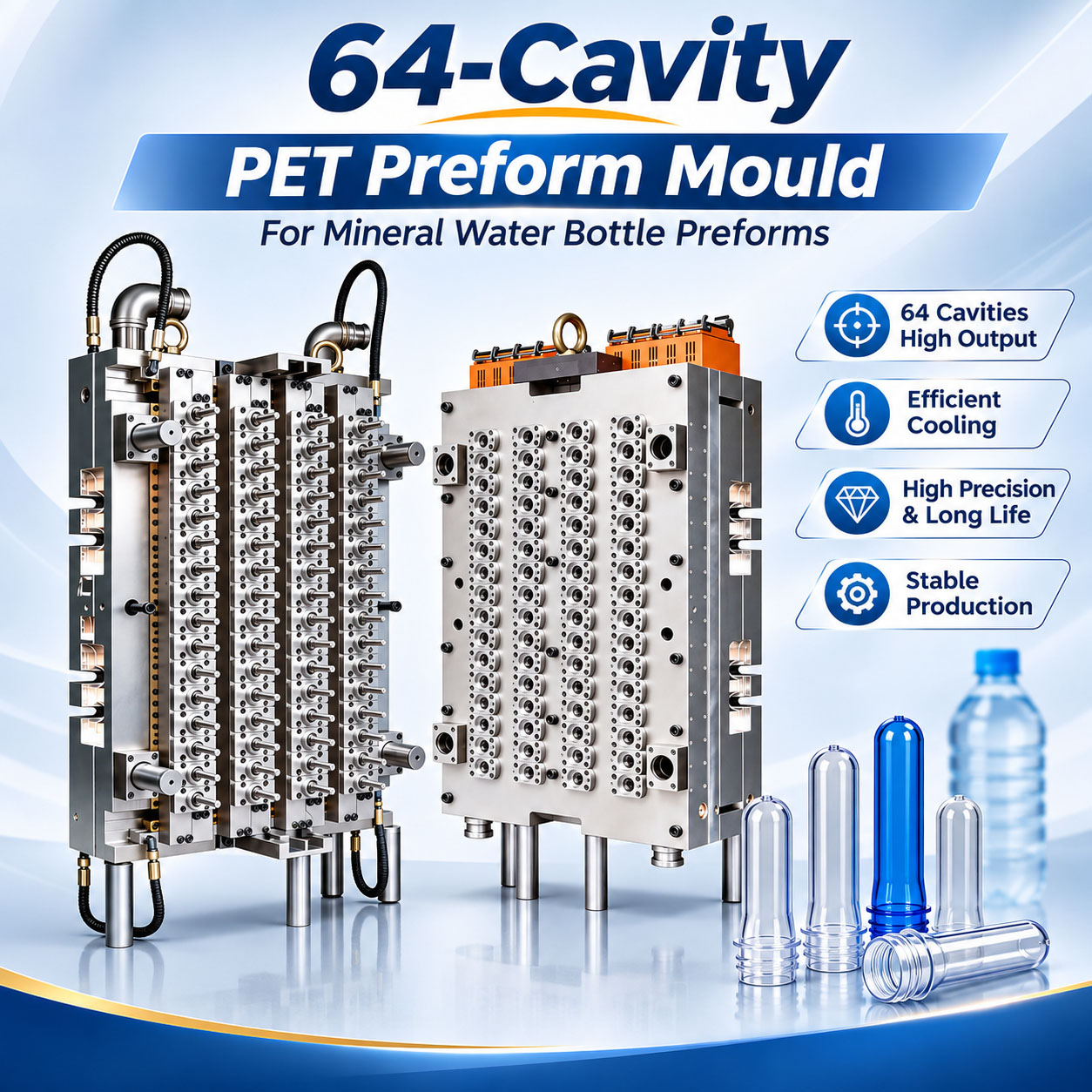
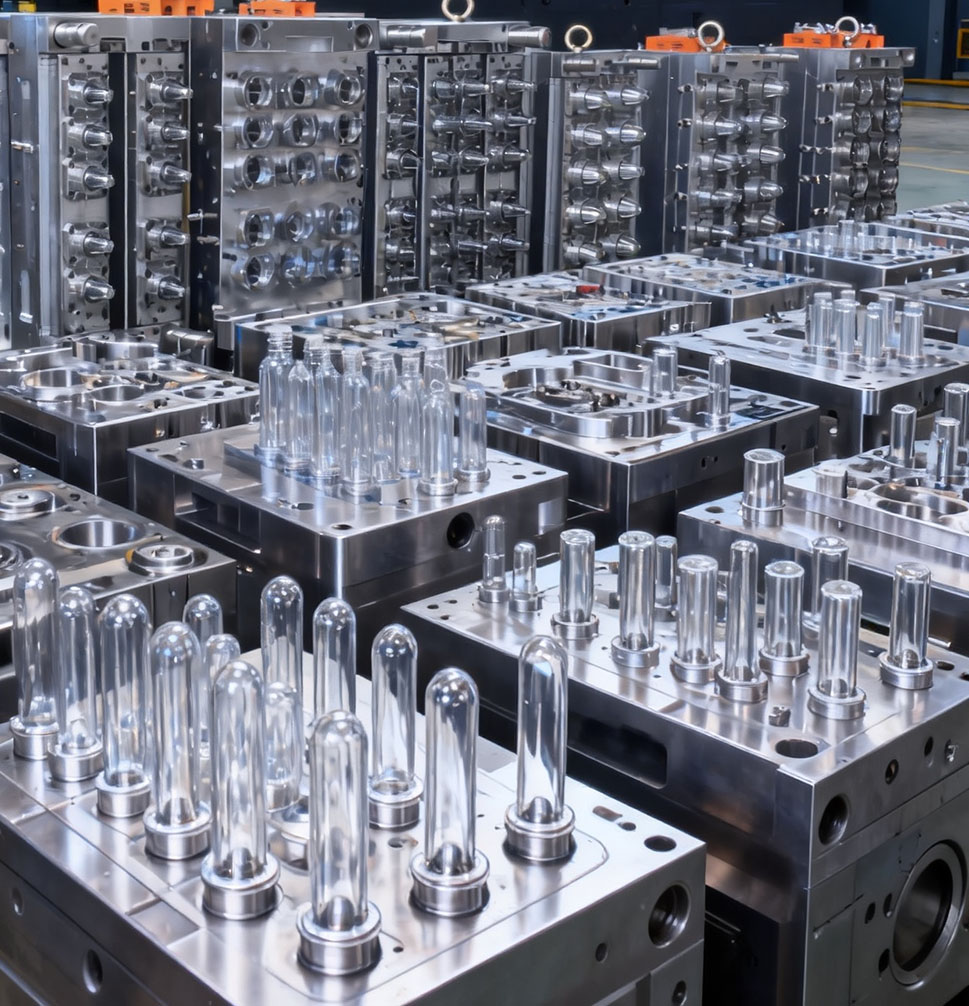
While many production managers attempt to accelerate output by simply lowering chiller temperatures or increasing injection speeds on the molding machine, true sustainable cycle time reduction starts at the core of the process: the precision engineering of the PET preform mold. At Debodi Mould, we engineer high-cavitation PET preform tooling designed to maximize heat transfer efficiency, minimize shear stress, and maintain low acetaldehyde (AA) levels at ultra-fast cycle speeds.
1. Anatomy of a PET Preform Injection Cycle
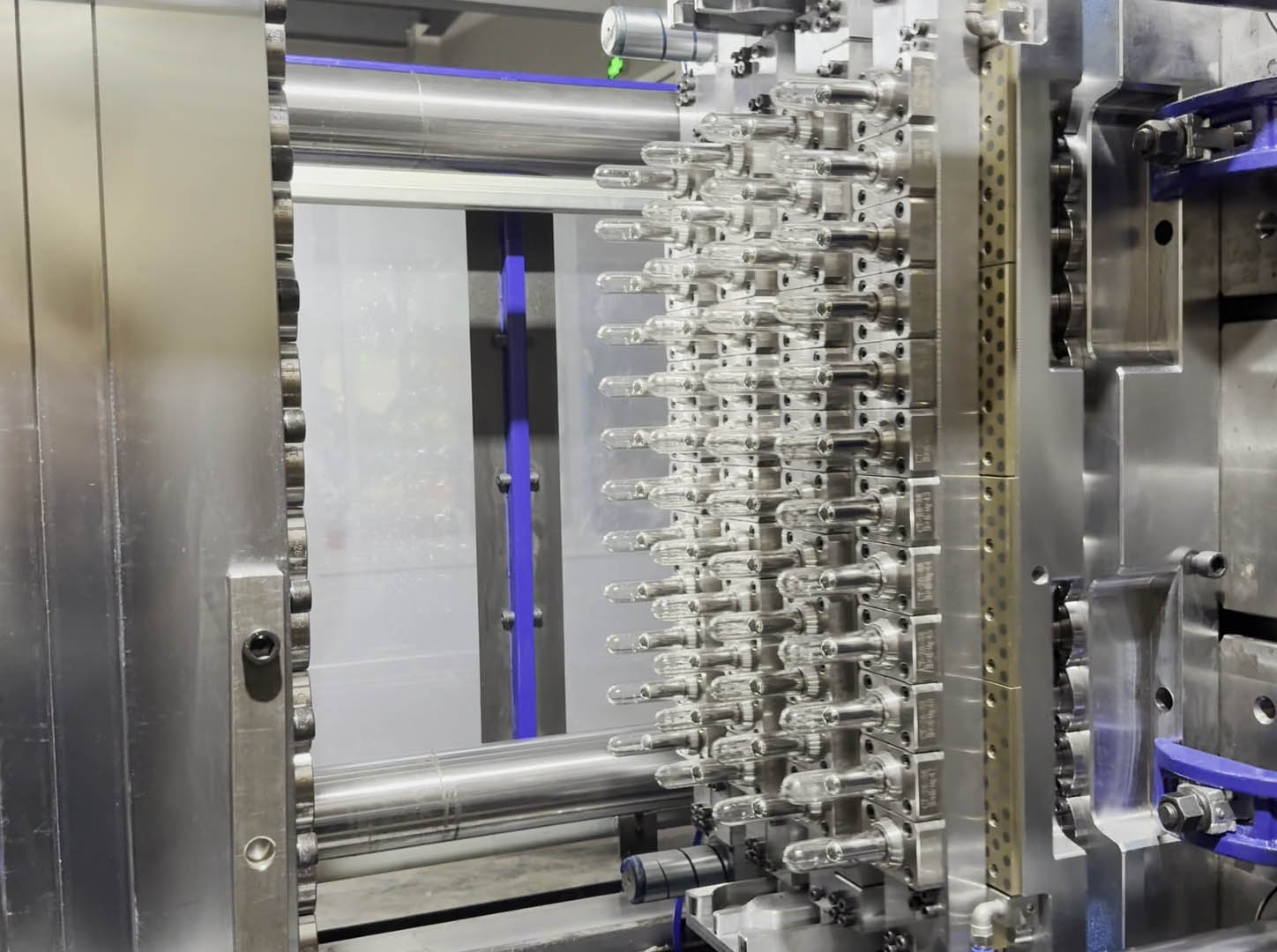
To optimize cycle time systematically, engineers must first break down where seconds are spent inside the mold. In a typical PET preform molding cycle, time is distributed across four primary phases:
- Cooling Time (50% – 65%): The single largest bottleneck, dictated by preform wall thickness and mold thermal conductivity.
- Injection & Holding Time (15% – 25%): Determined by melt viscosity, hot runner pressure drop, and gate freeze speed.
- Mold Open, Ejection & Close / Dry Cycle (10% – 15%): Governed by mold mechanical precision, taper alignment, and robotic take-out synchronization.
- Dosing / Plasticizing (Overlapped): Occurs during cooling, though excessive backpressure can delay recovery.
Because cooling accounts for more than half of the total cycle, thermal management within the cavity, core, and neck ring represents the highest-leverage opportunity for cycle time reduction.
2. Advanced Cooling Channel Engineering: Maximizing Heat Extraction
PET is a semi-crystalline thermoplastic with relatively low thermal conductivity. If heat is not extracted rapidly and uniformly after injection, preforms suffer from visual haze (crystallinity), shrinkage distortion, or ovality upon ejection.
Optimized Turbulent Flow in Cores and Cavities
Laminar water flow creates a stagnant thermal boundary layer inside cooling channels, severely insulating the steel from the coolant. At Debodi Mould, every cooling circuit is fluid-dynamically calculated to maintain a Reynolds Number ($Re$) above 4,000, ensuring vigorous turbulent flow across every single cavity—from 16-cavity to 144-cavity molds.
High-Conductivity Beryllium-Free Alloys & Conformal Cooling
While standard S136 stainless steel provides exceptional corrosion resistance and optical polishability, strategic integration of high-thermal-conductivity alloys in critical heat-accumulation zones (such as the gate insert and neck split) accelerates heat dissipation by up to 35% compared to conventional straight-drilled steel channels.
3. Valve-Gate Hot Runner Optimization & Shear Heating Control
A common mistake in high-speed PET production is forcing melt faster through undersized runner channels. Excessive shear rates generate frictional heat, spiking melt temperature and forcing the cooling system to work harder—ultimately increasing cycle time and elevating Acetaldehyde (AA) generation.
- Rheologically Balanced Melt Channels: Our hot runner manifolds utilize natural rheological balancing with mirror-polished flow bores to ensure identical pressure drop and residence time across all cavities.
- Precision Pneumatic/Servo Valve Pins: High-speed actuation with tapered shut-off geometry ensures instantaneous gate freeze, eliminating stringing and allowing earlier screw recovery.
- Independent Nozzle Thermal Zoning: Tight PID temperature control ($\pm 1^\circ\text{C}$) prevents localized cold slugs or thermal degradation at the gate tip.
4. Post-Mold Cooling (Take-Out Plate) Integration
Modern high-output PET preform systems no longer cool the preform 100% inside the injection mold. Instead, the mold cools the outer skin of the preform just enough to prevent mechanical deformation during robotic ejection, transferring the remaining 30% to 40% of thermal extraction to a water-cooled post-mold take-out plate.
To make this work reliably, Debodi Mould engineers self-centering tapered interlocks and ultra-smooth, low-friction core coatings (such as TiN or CrN) so preforms release cleanly at higher core temperatures without scuffing or vacuum retention.
5. Technical Comparison: Standard vs. High-Speed Debodi PET Preform Molds
The table below illustrates the measurable performance differences between conventional PET tooling and high-efficiency molds engineered by Debodi Mould (based on a standard 28mm PCO 1881, 21g water preform):
| Engineering Parameter | Conventional PET Mold | Debodi High-Speed PET Mold | Operational Impact |
|---|---|---|---|
| Total Cycle Time (21g Preform) | 11.5 – 13.0 seconds | 8.2 – 9.5 seconds | +25% to +35% hourly output |
| Cooling Channel Flow Regime | Transitional ($Re \approx 2,200$) | Full Turbulent ($Re > 4,500$) | Uniform wall crystallization control |
| Hot Runner Pressure Drop | > 350 bar | < 240 bar | Lower shear heating & energy draw |
| Acetaldehyde (AA) Level | 4.5 – 6.0 ppm | < 2.5 ppm | Safe for still & sparkling water |
| Guaranteed Mold Lifespan | 3 – 5 Million Shots | > 8 – 10 Million Shots | Reduced downtime & TCO |
6. Checklist for Selecting a High-Speed PET Preform Mold Partner
Before commissioning your next high-cavitation PET mold, verify that your tooling manufacturer provides:
- Moldflow & Thermal Simulation Reports: Pre-production verification of fill balance, shear rate distribution, and cooling uniformity.
- Interchangeable Cavity/Core Architecture: Precision CNC tolerances ($\pm 0.003\text{ mm}$) allowing single-cavity spare replacement without re-fitting the entire mold base.
- Integrated Post-Mold Cooling Compatibility: Seamless alignment between mold ejector stroke and multi-stage robotic take-out tubes.
- Full-Load Factory Acceptance Testing (FAT): High-speed dry-cycle and live resin trial runs validating cycle time, weight consistency ($\pm 0.05\text{ g}$), and AA compliance prior to shipment.
Frequently Asked Questions (FAQ)
How does reducing cycle time affect PET preform clarity and Acetaldehyde (AA) levels?
If cycle time is reduced solely by raising injection speed or melt temperature, shear stress increases, causing haze and high AA levels. However, when cycle time is reduced through superior mold cooling efficiency and balanced low-shear hot runners—as engineered by Debodi Mould—melt residence time decreases, actually lowering AA levels and improving optical clarity.
What is the single most effective mold upgrade to shorten PET injection cycle time?
Combining high-turbulence core/cavity cooling with a multi-stage water-cooled post-mold take-out plate delivers the fastest ROI, typically reducing total cycle time by 20% to 30% compared to in-mold-only cooling setups.
Does Debodi Mould provide custom PET preform mold solutions for existing injection machines?
Yes. Debodi Mould custom-engineers molds ranging from 1-cavity lab molds up to 144-cavity high-speed production systems tailored to your exact press tie-bar spacing, platen dimensions, injection unit shot capacity, and downstream blow-molding neck finish requirements (PCO 1881, PCO 1810, 30/25, 38mm, 48mm, and custom closures).